Benefits of Becoming a Distributor in India | GrowDistributors
Benefits of Becoming a Distributor: Why Distribution Can Be a Smart Business Opportunity in India
Starting a business does not always mean creating a product, setting up a factory, or building a brand from scratch. Sometimes, a smarter approach is to partner with an established manufacturer and take its products to the market.
That is exactly where becoming a distributor can be a valuable business model.
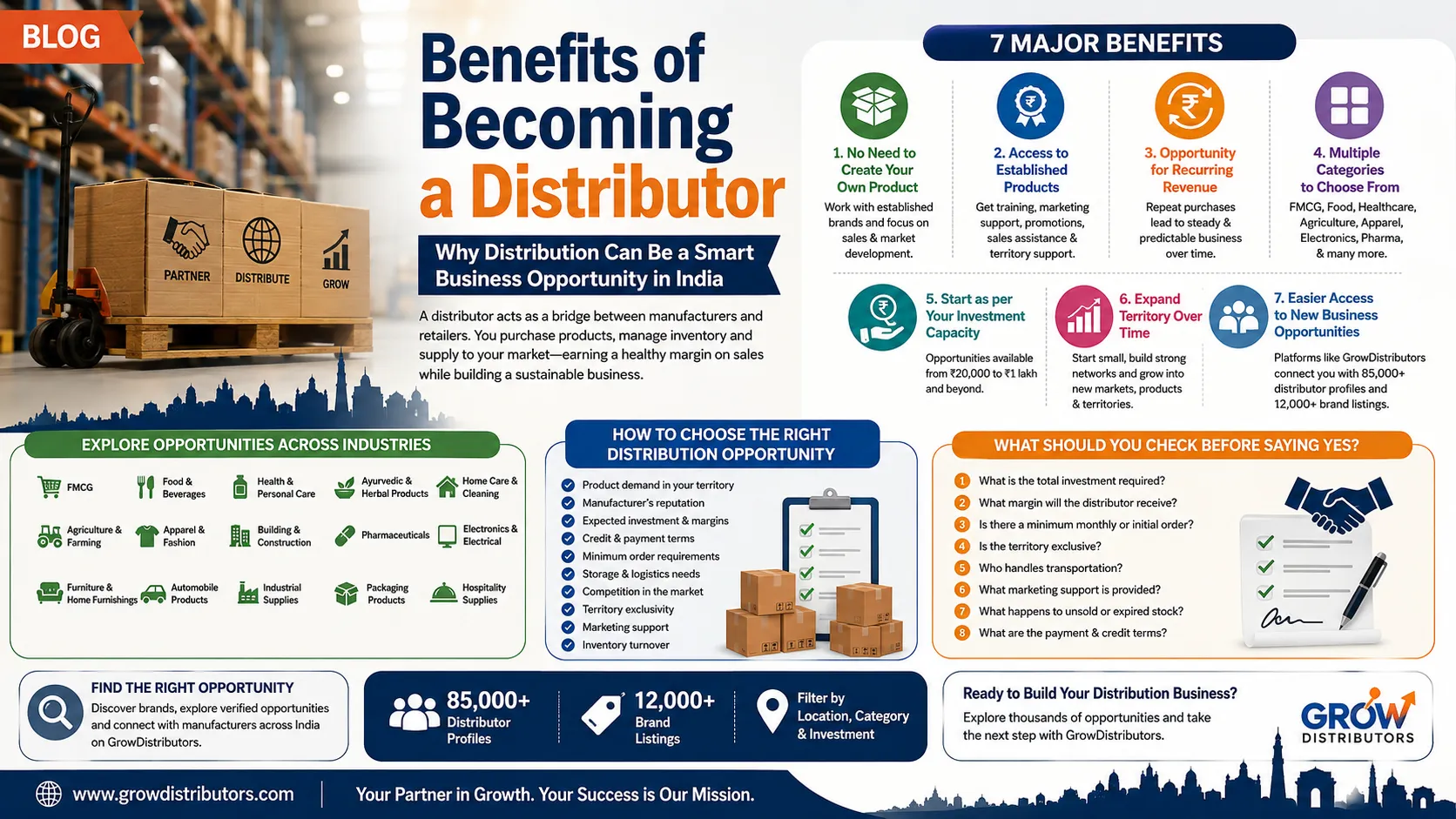
A distributor acts as a bridge between manufacturers and retailers, dealers, institutions, or other businesses. You purchase products from a brand, manage inventory, and supply them to your market. In return, you earn a margin on sales.
For entrepreneurs looking for distributorship opportunities or people searching for distributor opportunities in India, this model can offer a practical way to enter the business world without having to develop a product themselves.
What Does a Distributor Actually Do?
A distributor is responsible for making a manufacturer's products available in a particular territory or market.
Depending on the business, a distributor may handle the following:
- Purchasing products from manufacturers
- Maintaining stock and warehouse inventory
- Supplying products to retailers and dealers
- Developing relationships with local businesses
- Managing deliveries and logistics
- Supporting product promotions
- Generating repeat orders
- Expanding the brand's presence in the assigned territory
The exact responsibilities, investment and margins vary from one company and category to another.
For example, someone looking for an FMCG distributor wanted opportunity may need a strong retailer network and regular delivery capability, while an industrial-product distributor may need technical knowledge and a different type of customer base.
7 Major Benefits of Becoming a Distributor
1. You Don't Have to Create Your Own Product
One of the biggest advantages is that you don't have to spend years developing a product or building manufacturing infrastructure.
Instead, you work with an existing brand and focus on sales, distribution and market development.
This makes distribution attractive for entrepreneurs who are good at networking, sales and business development.
2. Access to Established Products
When you partner with a manufacturer, you may get access to products that already have a defined market proposition.
Depending on the brand, you may also receive:
- Product training
- Marketing support
- Promotional material
- Sales assistance
- Territory support
- New-product information
This can reduce some of the challenges associated with launching a completely new business.
3. Opportunity to Build Recurring Revenue
Distribution is generally based on repeat purchases rather than one-time transactions.
Think about products such as packaged foods, cleaning products, personal-care items or agricultural supplies. Retailers need to replenish their inventory regularly.
This means a distributor who builds a strong retailer network can potentially create recurring sales rather than constantly searching for new customers.
However, profitability is not guaranteed. It depends on product demand, margins, operating expenses, competition, inventory turnover and the terms agreed with the manufacturer.
4. Multiple Categories to Choose From
One of the most interesting aspects of the distribution business is the number of industries available.
Depending on your location, investment capacity and experience, you can explore categories such as:
- FMCG
- Food & beverages
- Health & personal care
- Ayurvedic & herbal products
- Home-care and cleaning products
- Agriculture & farming
- Apparel & fashion
- Building & construction
- Pharmaceuticals
- Electronics & electrical products
- Furniture and home furnishings
- Automobile products
- Industrial supplies
- Packaging products
- Hospitality supplies
GrowDistributors currently lists opportunities across many of these categories, including Food & Beverage, Health & Personal Care, Ayurvedic & Herbal Products, Home Care, Apparel, Agriculture, Building & Construction, Pharmaceuticals, Electronics and industrial categories.
5. You Can Start According to Your Investment Capacity
Not every distribution opportunity requires the same amount of capital.
Current listings on GrowDistributors, for example, show opportunities with different investment ranges, including ₹20,000–₹50,000, ₹50,000–₹1 lakh, ₹1–₹2 lakh and higher investment levels. Actual requirements depend on the specific brand and territory.
This allows aspiring entrepreneurs to shortlist opportunities that are more realistic for their financial situation.
6. Opportunity to Expand Territory Over Time
You don't necessarily have to start with an entire state or a large territory.
Many businesses begin by serving one city or a smaller region. Once sales become stable, they can explore additional territories, products or brands.
For someone who became a distributor of one successful product line, adding complementary products can also be a way to increase revenue from the same retailer network.
The key is to expand carefully rather than taking on too much inventory too quickly.
7. Easier Access to New Business Opportunities
Traditionally, finding manufacturers often meant attending trade fairs, making countless phone calls or relying on personal contacts.
Digital B2B platforms are changing this process.
GrowDistributors says manufacturers and brands can connect with distributors, dealers and super-stockists across India. Its platform currently states that it provides access to 85,000+ distributor profiles and 12,000+ brand listings, with options to filter opportunities by location and investment.
For someone searching for wanted distributorship in India, this can make the initial discovery process more convenient.
How to Choose the Right Distribution Opportunity
Getting an opportunity is one thing. Choosing the right one is another.
Before investing, consider:
- Product demand in your territory
- Manufacturer's reputation
- Expected investment
- Distributor margin
- Credit and payment terms
- Minimum order requirements
- Storage requirements
- Competition in the market
- Territory exclusivity
- Marketing support
- Expected inventory turnover
Don't select an opportunity simply because the advertised margin looks attractive. A 30% margin on a product that barely sells may be less valuable than a smaller margin on a product with consistent demand.
How GrowDistributors Can Help Aspiring Distributors
If you are searching for distributor opportunities, GrowDistributors can help you discover brands and distribution requirements in different categories and locations.
The platform allows users to explore available opportunities, filter listings and send enquiries directly to brands.
This can be particularly useful for people looking for distributor-needed opportunities without having to depend entirely on offline contacts.
For example, current listings include opportunities in categories such as FMCG, food, Ayurvedic products, home care, sports products and health & personal care, with different investment and territory requirements.
What Should You Check Before Saying Yes?
Before signing any agreement, ask the manufacturer:
- What is the total investment required?
- What margin will the distributor receive?
- Is there a minimum monthly or initial order?
- Is the territory exclusive?
- Who handles transportation?
- What marketing support is provided?
- What happens to unsold or expired stock?
- What are the payment and credit terms?
These questions can help you understand the real economics of the opportunity instead of making a decision based only on the advertised margin.
Frequently Asked Questions
1. Is becoming a distributor a good business opportunity?
It can be a good option for people with sales, networking, inventory-management or local-market experience. However, success depends heavily on product demand, manufacturer support, territory, margins and working-capital management.
2. How much money is required to become a distributor?
There is no fixed amount. Investment can range from relatively small amounts to several lakhs depending on the product, inventory, territory and manufacturer. Current GrowDistributors listings demonstrate a wide range of investment requirements.
3. Which categories offer distributorship opportunities?
Popular categories include FMCG, food and beverages, agriculture, home care, personal care, Ayurvedic products, apparel, pharmaceuticals, electronics, construction and industrial products.
4. How can I find distributors required for new products?
If you are a manufacturer looking for partners, you can use B2B distribution platforms such as GrowDistributors to post requirements and connect with potential distributors across different markets.
5. How can I find distributorship opportunities in India?
You can explore manufacturer websites, trade exhibitions, industry networks and B2B platforms. GrowDistributors provides a dedicated marketplace for discovering brand and distribution opportunities across multiple categories and locations.
Final Thoughts
Becoming a distributor can be an attractive way to enter the business world without manufacturing your own products. The model gives entrepreneurs the opportunity to work with established brands, develop local markets and potentially build recurring business through retailer relationships.
But the most important decision is not simply which brand should I choose? It is which product, territory and business model make sense for me?
Take time to compare opportunities, understand the investment, check the manufacturer's terms and study demand in your local market.
Whether you are exploring distributorship opportunities, searching for wanted distributorship in India, or looking for specific distributor opportunities, platforms such as GrowDistributors can make it easier to discover potential partnerships and take the next step toward building a distribution business.