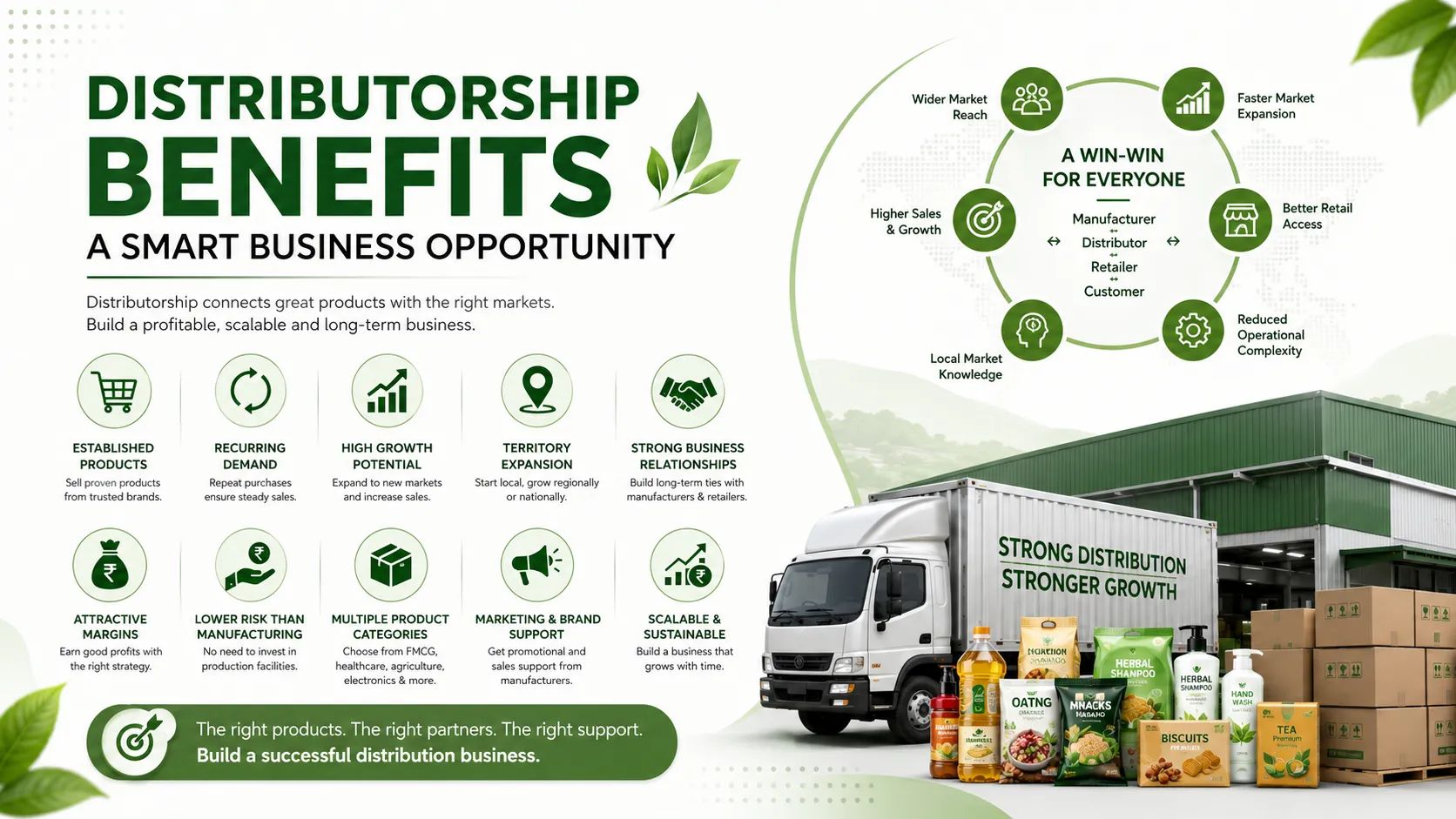
Distributorship Benefits: 10 Key Benefits of Distribution Business
Distributorship Benefits: Why a Distribution Business Can Be a Smart Opportunity in India
A distributorship business can be an attractive opportunity for entrepreneurs who want to build a business around established products without getting involved in manufacturing. From FMCG and food products to personal care, agriculture, electronics, healthcare, and industrial products, manufacturers across India depend on distributors to reach retailers and customers in different markets.
The basic role of a distributor is simple: purchase products from a manufacturer or brand, maintain inventory, supply products to retailers or other sales channels, and develop the market within an assigned territory.
But the benefits of a distributorship business go beyond simply buying and selling products. A well-managed distributorship can provide recurring demand, opportunities for territory expansion, multiple revenue possibilities and the ability to build long-term relationships with manufacturers and retailers.
India's distribution ecosystem is also becoming increasingly important as brands expand into smaller cities and rural markets. In 2026, the government highlighted the importance of digitising procurement across India's general trade ecosystem, which includes more than 1.4 crore kirana stores.
What Is a Distributorship Business?
A distributorship business works as a link between a manufacturer or brand and the market.
A typical distribution chain can look like:
Manufacturer → Distributor → Retailer/Dealer → Customer
Depending on the industry, there may also be super-stockists, wholesalers, institutional buyers, e-commerce sellers or other channel partners involved.
The distributor generally takes responsibility for activities such as:
- Purchasing and maintaining product inventory
- Supplying products to retailers and dealers
- Managing orders and collections
- Developing relationships with local businesses
- Expanding product availability within a territory
- Supporting product visibility and promotions
- Managing logistics and stock movement
This model allows manufacturers to expand their market presence without having to directly manage every retailer or local market.
Major Distributorship Benefits for Entrepreneurs
1. Opportunity to Sell Established Products
One of the biggest distributorship benefits is that you do not necessarily need to create your own product.
Instead, you can partner with an existing manufacturer or brand that already has a product portfolio.
For example, a distributor may work with companies selling the following:
- FMCG products
- Packaged foods and beverages
- Personal care products
- Home care and cleaning products
- Ayurvedic and herbal products
- Agricultural products
- Electronics
- Furniture
- Building materials
- Machinery
- Healthcare products
This allows entrepreneurs to focus more on sales, distribution, and market development rather than product manufacturing.
2. Recurring Product Demand
Many distribution businesses deal with products that customers purchase repeatedly.
FMCG is a strong example. Items such as snacks, beverages, cleaning products, personal care products, and packaged foods need regular replenishment.
This repeat-purchase behavior can create a more predictable sales cycle compared with businesses that depend primarily on occasional purchases.
However, recurring demand does not automatically guarantee profitability. Product selection, pricing, margins, inventory management and retailer coverage remain critical.
3. Multiple Product Categories
Another important benefit of distributorship business is the variety of industries available.
You are not restricted to one type of product.
Depending on your investment, market knowledge and infrastructure, you may explore opportunities in categories such as:
FMCG: Food, beverages, snacks and household products
Health & Personal Care: Cosmetics, skincare, wellness and hygiene products
Agriculture: Seeds, equipment, farming products and agricultural inputs
Building & Construction: Hardware, construction materials and related products
Electronics: Consumer electronics, accessories and electrical products
Furniture: Home, office and commercial furniture
This variety gives distributors the opportunity to select products that match their local market.
4. Scope for Territory Expansion
Distributorship can start within a relatively focused geographical area and expand as the business develops.
For example, a distributor may initially cover the following:
One City → Multiple Cities → District → State → Larger Territory
Expansion depends on the manufacturer's distribution policy, market demand, infrastructure, and the distributor's ability to manage additional volume.
Rural and smaller-city markets are particularly important for consumer brands. Companies are increasingly focusing on distribution-led expansion beyond major metros as consumption opportunities develop in smaller markets.
This makes territory expansion one of the important long-term distributor business benefits.
5. Lower Complexity Than Manufacturing
Manufacturing a product requires significant investment in areas such as:
- Production facilities
- Machinery
- Raw materials
- Quality control
- Product development
- Packaging
- Manufacturing compliance
- Production staff
A distributor generally does not need to manage the manufacturing process.
Instead, the primary focus is on:
Inventory + Sales + Retail Network + Logistics + Market Expansion
This can make distributorship an appealing model for entrepreneurs who want to operate a product-based business without setting up their own manufacturing unit.
However, distributors still need sufficient working capital, storage, transportation and operational systems.
6. Potential for Long-Term Business Relationships
A successful distributor does more than move products.
Over time, distributors can develop relationships with:
- Manufacturers
- Retailers
- Dealers
- Wholesalers
- Supermarkets
- Institutional buyers
- E-commerce sellers
These relationships can become an important business asset.
A distributor who consistently maintains product availability, delivers on time and supports retailers can become a valuable channel partner for manufacturers.
Research into FMCG distributor experience also shows that growth opportunities, operational ease, communication and brand support can strongly influence distributor retention and investment decisions.
7. Multiple Ways to Grow Revenue
A distribution business can potentially increase revenue through several growth levers.
These may include:
- Increasing the number of retailers served
- Expanding geographical coverage
- Adding new product categories
- Increasing order frequency
- Improving inventory turnover
- Working with additional brands where permitted
- Entering new sales channels
- Developing institutional or wholesale customers
The exact earning model depends on the manufacturer agreement and product category.
Distributors may earn through product margins, trade schemes, incentives or volume-based programs, depending on the business model.
Therefore, entrepreneurs should evaluate the complete commercial structure rather than focusing only on the headline margin.
8. Growing Opportunities in Tier-2 and Tier-3 Markets
One of the biggest opportunities for distributors is the expansion of consumer markets beyond major cities.
Smaller cities and rural markets are becoming increasingly important for consumer brands. At the same time, companies need local partners who understand retailers, transportation routes, customer preferences and market conditions.
For manufacturers, working with local distributors can help them enter new markets faster.
For entrepreneurs, this creates potential distributorship opportunities in India outside traditional metropolitan markets.
The growth of digital procurement is also changing how retailers, distributors and brands interact. Government and industry stakeholders are actively working toward greater digitalisation of India's general trade ecosystem.
9. Opportunity to Build a Scalable Business
A small distribution operation can potentially grow into a larger network.
For example:
Small Distributor → Regional Distributor → Multi-City Distributor → Large Distribution Network
Growth can come from increasing retailer coverage, adding products, expanding territories and improving operational efficiency.
However, scalability requires strong inventory management, reliable logistics, working-capital planning and good relationships with channel partners.
A distributor should therefore think beyond short-term sales and build systems that can handle increasing order volumes.
10. Access to Manufacturer Support
Depending on the company, manufacturers may provide distributors with different types of support.
This can include:
- Product training
- Marketing material
- Sales support
- Promotional schemes
- Product information
- Territory guidance
- Inventory recommendations
- Branding support
The level of support varies from company to company.
This is why entrepreneurs should carefully review the distributor agreement before investing.
Important points to understand include:
- Territory rights
- Minimum purchase requirements
- Payment terms
- Product margins
- Return and damage policies
- Expiry management
- Marketing support
- Sales targets
- Exclusivity conditions
What Are the Benefits of Distributorship for Manufacturers?
The advantages are not limited to distributors. Manufacturers can also gain significant benefits from a strong distribution network.
Wider Market Reach
Distributors help manufacturers take products into cities, towns and local markets that may be difficult to manage directly.
Faster Market Expansion
Instead of building a sales and logistics operation from scratch in every territory, manufacturers can work with established local channel partners.
Better Retailer Access
Local distributors may already have relationships with retailers and wholesalers, helping brands improve market penetration.
Lower Operational Complexity
A strong distributor network can reduce the need for manufacturers to directly manage every local delivery, retailer relationship and collection.
Local Market Knowledge
Distributors understand local purchasing behaviour, retailer expectations and competitive conditions. This information can help manufacturers make better market decisions.
This is particularly important in India's fragmented retail ecosystem, where distribution remains a major route to market.
How to Choose the Right Distributorship Opportunity
While there are many distributorship opportunities, not every opportunity will be suitable for every entrepreneur.
Before investing, evaluate the following:
1. Product Demand
Check whether consumers and retailers actually need the product.
2. Product Quality
A distributor's reputation can be affected by poor-quality products.
3. Profit Margins
Understand gross margin as well as operating costs such as transportation, staff, storage and credit.
4. Investment Requirement
Calculate the required inventory, warehouse, vehicle and working capital.
5. Territory
Understand exactly which cities, districts or markets you are allowed to serve.
6. Competition
Check competing brands and existing distributors in the territory.
7. Manufacturer Support
Evaluate sales, marketing, logistics and product support.
8. Shelf Life and Inventory Risk
This is especially important for food, FMCG and other expiry-sensitive products.
9. Payment Terms
Understand credit periods, payment schedules and collection requirements.
10. Growth Potential
Ask whether the product portfolio and company have the potential to expand into new markets and categories.
How GrowDistributors Helps Businesses Find Distribution Opportunities
Finding the right manufacturer or distributor can often be one of the most difficult parts of building a distribution network.
A manufacturer may have a good product but struggle to find reliable channel partners. Similarly, an entrepreneur may have investment capacity, warehouse infrastructure and retailer connections but may not know which companies are currently looking for distributors.
Platforms such as GrowDistributors help bridge this gap by connecting manufacturers, brands, distributors, dealers and other business partners.
Manufacturers can use such platforms to:
- Publish distributor requirements
- Reach potential channel partners
- Expand into new territories
- Increase business visibility
- Find partners based on location and category
Entrepreneurs can use distribution platforms to explore:
- FMCG distributorship
- Food and beverage opportunities
- Health and personal care
- Ayurvedic and herbal products
- Home care and cleaning
- Agriculture
- Electronics
- Machinery
- Furniture
- Building and construction
This creates a more structured way for businesses to discover potential distribution partnerships.
Things to Consider Before Starting a Distributorship Business
Despite the many distributorship benefits, this business is not completely risk-free.
Common challenges can include:
- Unsold inventory
- Delayed retailer payments
- Working-capital pressure
- Transportation costs
- Competition between brands
- Expired or damaged stock
- Sales targets
- Territory conflicts
- Inconsistent product supply
Recent research on rural FMCG distribution has also highlighted issues such as delivery disruptions, inventory inefficiencies and financial stress in fragmented distribution networks.
Therefore, choosing the right company is just as important as having sufficient investment.
Final Thoughts
The benefits of distributorship business make it an interesting option for entrepreneurs who want to build a product-based business without manufacturing their own products.
Recurring demand, multiple product categories, territory expansion, manufacturer support, retailer relationships and scalability can all contribute to long-term business potential.
At the same time, success depends on selecting the right product, understanding the market, maintaining healthy inventory, managing working capital and building a strong retailer network.
Whether you are a manufacturer searching for a distributor wanted in a new market or an entrepreneur looking for distributorship opportunities in India, finding the right business partner can make market expansion significantly easier.
A strong distribution network is not simply about moving products from one location to another. It is about creating a reliable connection between manufacturers, distributors, retailers and customers.
Frequently Asked Questions
1. What are the main benefits of distributorship?
The major distributorship benefits include recurring product demand, access to established products, multiple product categories, territory expansion, scalable operations, manufacturer support and opportunities to build long-term retailer relationships.
2. Is distributorship a profitable business?
Distributorship can be profitable, but profitability depends on product demand, margins, sales volume, operating expenses, working-capital requirements and inventory management. Entrepreneurs should calculate the complete economics before investing.
3. What products are suitable for distributorship?
Products with consistent demand and repeat purchases can be suitable for distribution. Common categories include FMCG, food and beverages, personal care, home care, agriculture, electronics, furniture, healthcare, and construction products.
4. What should I check before taking a distributorship?
Check the manufacturer's reputation, product demand, investment requirement, margins, territory rights, minimum order requirements, payment terms, inventory risk, competition and manufacturer support.
5. Can a distributor expand into multiple cities?
Yes, distributors can potentially expand into multiple cities depending on the manufacturer's territory policy, available infrastructure, working capital, sales network and business performance.
6. How can I find distributorship opportunities in India?
Entrepreneurs can explore manufacturers and brands looking for channel partners through B2B distribution platforms such as GrowDistributors. It is important to verify the company, product demand, commercial terms and territory before making an investment.
7. Are distributorship opportunities available outside FMCG?
Yes. Distribution opportunities are available across industries such as agriculture, healthcare, personal care, electronics, machinery, furniture, construction, food and beverages, home care and many other categories.