How to Become a Distributor in India: Find the Right Business Opportunity
If you are looking for a business opportunity where you can work with established manufacturers and sell products in your local market, becoming a distributor can be worth exploring.
Every day, businesses search for products, brands, and manufacturers that need distribution partners across different cities and states.
You may have already come across searches such as "distributor needed," "FMCG distributor wanted," or “distributors required for new products.”
But before you become a distributor, there are several things you should understand.
Distribution is not simply about buying products and selling them again. It involves inventory, retailer relationships, working capital, logistics and consistent market development.
What Does It Mean to Become a Distributor?
A distributor acts as a link between a manufacturer and the market.
Depending on the business model, you may purchase products from a manufacturer and supply them to:
- Retailers
- Dealers
- Wholesalers
- Supermarkets
- Businesses
- Institutional customers
Your exact responsibilities depend on the manufacturer and product category.
The opportunity can be attractive for entrepreneurs who already understand their local market or have existing retailer relationships.
Why Are Manufacturers Looking for Distributors?
Manufacturers often want to expand beyond their existing markets.
Instead of building their own sales and delivery network in every city, they can work with local distribution partners.
This creates opportunities for entrepreneurs searching for distributor opportunities.
A manufacturer may need distributors because they want to:
- Enter new cities
- Expand into new states
- Increase retailer coverage
- Improve product availability
- Increase sales
- Build regional market presence
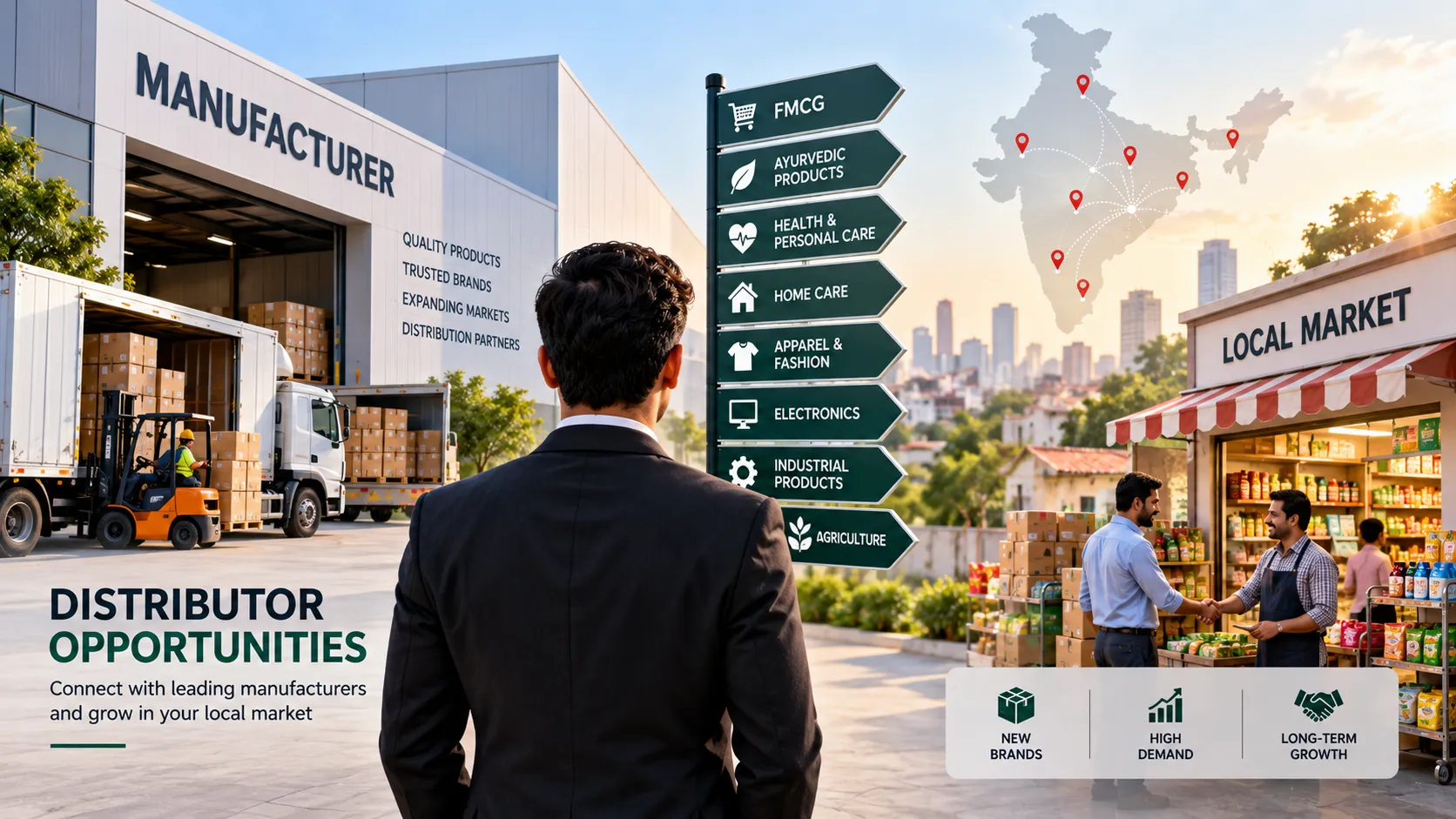
Which Distributorship Opportunities Can You Explore?
There isn't one single type of distribution business.
You can explore opportunities in categories such as
FMCG
Food, beverages, groceries, and everyday consumer products.
Agriculture & Farming
Agricultural products, equipment, and farming-related supplies.
Health & Personal Care
Beauty, hygiene, and personal-care products.
Ayurvedic Products
Herbal and Ayurvedic product categories.
Home Care & Cleaning
Household cleaners, detergents, and related products.
Apparel & Fashion
Clothing and fashion products.
Electronics
Consumer electronics and electrical products.
Industrial Products
Tools, equipment, and other B2B products.
Choosing a category that matches your existing experience can make market development easier.
FMCG Distribution Opportunities
Among the various categories, FMCG is often attractive because many products are purchased regularly.
When you see an FMCG distributor's wanted requirement, don't immediately focus on the margin.
Instead, ask:
Will this product actually sell in my market?
Consider:
- Local demand
- Competition
- Retailer acceptance
- Product pricing
- Product shelf life
- Manufacturer reputation
- Distribution margin
- Inventory turnover
A product with reasonable margins and consistent demand can be more useful than a product advertising a very high margin but generating little sales volume.
How Much Investment Is Required?
There is no universal amount required to become a distributor.
The investment can depend on:
- Product category
- Minimum order quantity
- Territory
- Warehouse requirements
- Inventory
- Transportation
- Sales staff
- Working capital
Before committing, ask the manufacturer for the complete investment requirement, rather than looking only at the initial stock value.
What Should You Ask the Manufacturer?
If you find an opportunity where a distributor's required requirement matches your location, ask these questions:
- What is the initial investment?
- What is the minimum order quantity?
- What margin will I receive?
- Is the territory exclusive?
- What sales targets apply?
- What marketing support is available?
- What are the payment terms?
- How frequently will products be supplied?
- How are damaged products handled?
- Is there a written agreement?
Getting clear answers can help you compare different opportunities.
Where Can You Find Distributorship Opportunities?
Entrepreneurs can discover potential opportunities through:
- Manufacturer websites
- Trade exhibitions
- Business networks
- Referrals
- Industry groups
- B2B marketplaces
- Distribution platforms
GrowDistributors is focused on connecting manufacturers and potential distributors.
Entrepreneurs exploring distributorship opportunities can discover brands and manufacturers looking for distribution partners, while manufacturers can showcase their requirements to potential distributors.
This makes the platform useful for both sides of the distribution ecosystem.
What Makes a Good Distribution Opportunity?
A good opportunity should have a reasonable balance between:
Product Demand + Investment + Margin + Territory + Competition + Manufacturer Support
Before investing, research the market instead of relying entirely on promotional claims.
You should also understand how much time and effort will be required to acquire retailers and generate sales.
Who Can Become a Distributor?
You don't necessarily need to be an established large company.
Depending on the manufacturer's requirements, potential distributors can include:
- Existing retailers
- Wholesalers
- Small business owners
- Entrepreneurs
- Trading companies
- Existing distributors
- Businesses with local market networks
The exact eligibility requirements vary from one manufacturer to another.
Common Mistakes New Distributors Make
Choosing Only Based on Margin
High margin doesn't guarantee high profit.
Ignoring Product Demand
A product needs customers.
Underestimating Working Capital
Your business may need funds for inventory, transportation, and operating expenses.
Not Understanding the Territory
Always know exactly where you can sell.
Trusting Guaranteed-Profit Claims
No legitimate business opportunity can guarantee that you'll earn a specific amount without considering market conditions and execution.
Frequently Asked Questions
How can I become a distributor in India?
Start by identifying suitable product categories, researching manufacturers, and evaluating investment, margins, territory, demand and commercial terms before entering into a distribution agreement.
Where can I find distributor opportunities?
You can explore manufacturer websites, trade exhibitions, B2B platforms, business networks, and specialized platforms such as GrowDistributors.
Is FMCG distribution a good business opportunity?
It can be, but profitability depends on product demand, margins, sales volume, competition, operating costs and manufacturer support.
How much money is needed to become a distributor?
There is no fixed amount. The requirement depends on the manufacturer, product, territory, MOQ, inventory and infrastructure.
What does “FMCG distributor wanted” mean?
It generally means an FMCG manufacturer or brand is looking for a business partner to distribute its products in a particular territory.
Final Thoughts
If you're searching for distributor opportunities, don't rush into the first offer you see.
Compare multiple manufacturers and evaluate the complete business model.
Look at the product, market demand, investment, margins, territory, competition and manufacturer support.
Whether you're looking to became a distributor, searching for FMCG distributor wanted opportunities or exploring new distributorship opportunities, proper research can help you make a more informed business decision.
For discovering potential manufacturers and distribution opportunities, GrowDistributors can also be a useful starting point.
The best opportunity isn't necessarily the one with the highest margin. It's the one that makes sense for your market and business capacity.