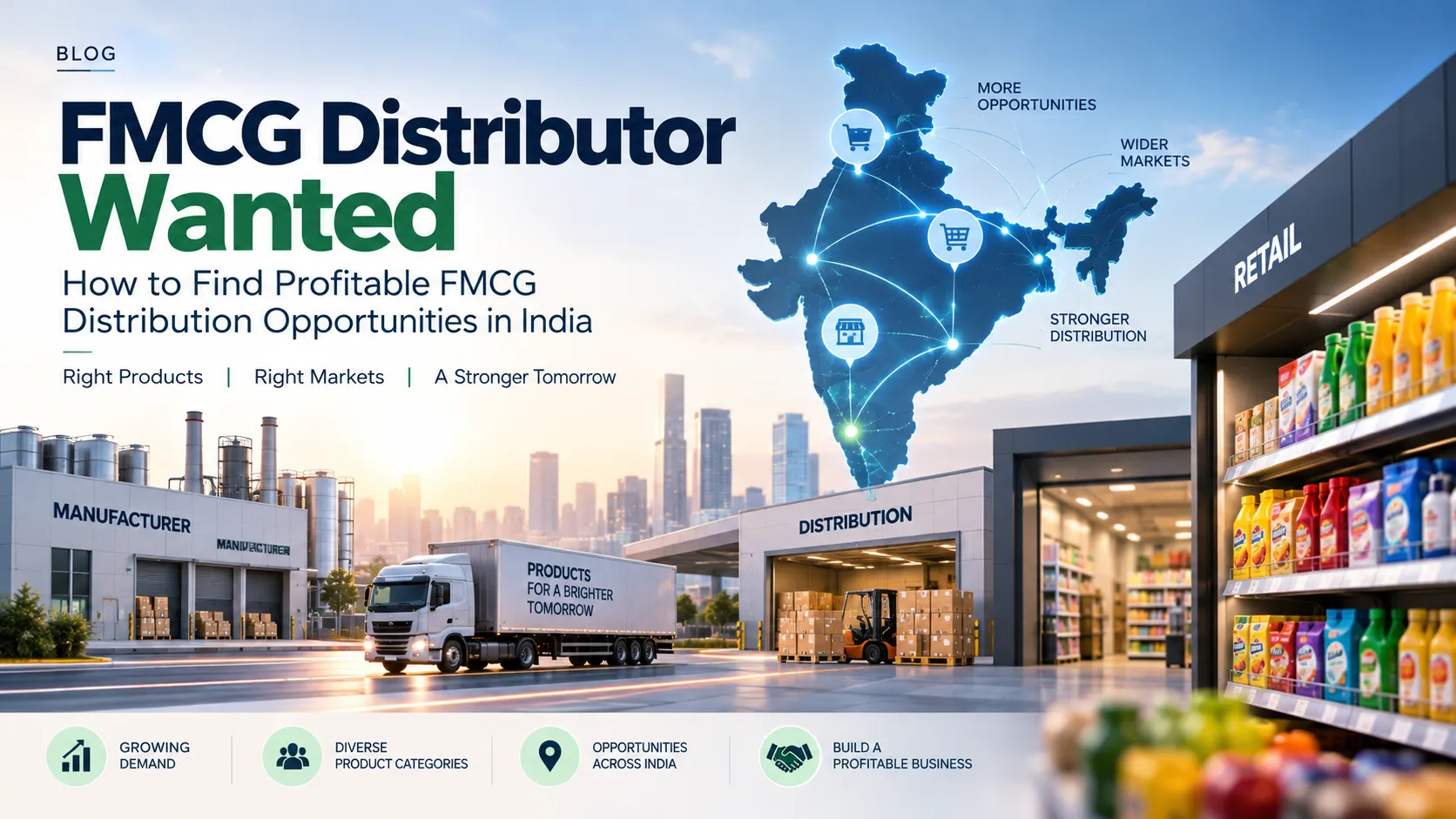
FMCG Distributor Wanted | Find FMCG Distributorship Opportunities
FMCG Distributor Wanted: How to Find Profitable FMCG Distribution Opportunities in India
Introduction
The FMCG sector continues to attract entrepreneurs who want to build a distribution-based business without manufacturing their own products.
From food and beverages to personal care, home care, and everyday consumer products, FMCG offers a wide range of distribution possibilities. But finding the right company and evaluating whether an opportunity is actually suitable requires careful research.
When you see an FMCG distributor wanted an opportunity, the important question is not simply, “Can I get this distributorship?”
The better question is:
“Is this the right FMCG distribution opportunity for my market, investment capacity and business goals?”
Here is how to evaluate one before committing your money and resources.
What Is an FMCG Distributor?
An FMCG distributor purchases products from a manufacturer or brand and supplies them to retailers, dealers, supermarkets, wholesalers, or other sales channels.
The typical supply chain can look like this:
Manufacturer → Distributor → Retailer → Consumer
The distributor's responsibilities may include:
- Purchasing inventory
- Maintaining stock
- Managing a warehouse
- Supplying retailers
- Developing local markets
- Managing sales teams
- Handling deliveries
- Collecting payments
- Supporting product promotions
The exact responsibilities depend on the company's distribution model.
Why FMCG Distribution Can Be Attractive
FMCG products are generally associated with regular consumer demand because they include products people purchase repeatedly.
Potential advantages include:
- Large product variety
- Repeat purchase potential
- Multiple market segments
- Opportunities across cities and states
- Established brands as well as new products
- Possibility of expanding retailer networks
- Multiple product categories
However, demand alone does not guarantee profitability.
Your actual results depend on product selection, pricing, margins, inventory turnover, competition, territory and execution.
What to Check When an FMCG Distributor Is Wanted
When you come across an FMCG distributor wanted listing, don't make a decision based only on the advertised investment.
Evaluate these factors first.
1. Product Demand
Ask whether customers in your target area actually need the product.
Consider:
- Local customer preferences
- Existing competition
- Product price
- Repeat purchase potential
- Seasonal demand
- Brand awareness
A product can be successful nationally but struggle in a particular local market.
2. Investment Requirement
Understand the complete financial requirement rather than only the initial inventory amount.
Your total requirement may include:
- Initial stock
- Warehouse
- Delivery vehicle
- Staff
- Sales representatives
- Working capital
- Marketing expenses
- Retailer credit
- Technology or software expenses
For example, an opportunity advertised as a low-investment distributorship may still require additional working capital to operate efficiently.
3. Distributor Margin
Margin is one of the most important commercial factors.
But don't look at the percentage alone.
Suppose Opportunity A offers a higher margin but products sell slowly.
Opportunity B offers a lower margin, but products move consistently.
Opportunity B may generate better overall business returns.
Therefore, evaluate:
Margin + Sales Volume + Inventory Turnover + Operating Costs
rather than margin alone.
4. Territory and Market Potential
A strong territory can significantly influence distribution performance.
Before accepting an opportunity, understand:
- Territory size
- Number of potential retailers
- Existing distributors
- Competition
- Urban/rural mix
- Delivery requirements
- Market demand
Ask whether the company is offering exclusive rights or appointing multiple distributors in the same territory.
5. Manufacturer Support
Good manufacturer support can make the distributor's job considerably easier.
Look for companies that provide appropriate support, such as
- Product training
- Sales material
- Marketing creatives
- Promotional schemes
- Product information
- Sales guidance
- Distributor onboarding
- Regular communication
Before becoming a distributor, ask exactly what support is included.
6. Existing Competition
Competition should be evaluated at the local level.
Research:
- Competing brands
- Retail prices
- Distributor margins
- Retailer incentives
- Product availability
- Customer reviews
- Brand visibility
If the market is already saturated, entering without a clear competitive advantage may be difficult.
7. Inventory Turnover
Inventory sitting in your warehouse represents blocked working capital.
For FMCG distribution, this makes inventory management particularly important.
Ask the company:
- What is the expected stock level?
- What is the typical reorder cycle?
- Which products sell fastest?
- Are slow-moving products returnable?
- How are damaged or expired products handled?
Never assume that every product in an FMCG portfolio will sell at the same speed.
Types of FMCG Distribution Opportunities
People searching for distributor opportunities can explore several categories.
Food & Beverages
Examples include:
- Packaged foods
- Snacks
- Beverages
- Spices
- Ready-to-eat products
- Health-focused foods
Personal Care
This can include:
- Skincare
- Haircare
- Grooming products
- Hygiene products
Home Care
Examples include:
- Cleaning products
- Laundry products
- Household consumables
- Surface cleaners
Ayurvedic & Herbal Products
This segment can include herbal personal care and wellness-oriented consumer products.
The best category depends on local demand, competition, investment capacity and your existing network.
How to Find FMCG Distributorship Opportunities
Instead of searching randomly for an FMCG distributor wanted advertisement, create a systematic process.
Step 1: Select Your Category
Decide whether you are interested in:
- Food
- Beverages
- Personal care
- Home care
- Spices
- Herbal products
- Other FMCG categories
Step 2: Select Your Territory
Decide whether you want to operate in:
- Your city
- Your district
- Multiple districts
- Your state
- Multiple states
Step 3: Set Your Investment Range
Know how much capital you can comfortably allocate to inventory and working capital.
Step 4: Compare Opportunities
Create a simple comparison based on:
| Factor | What to Check |
|---|---|
| Investment | Initial + working capital |
| Margin | Distributor earning potential |
| Demand | Local market demand |
| Territory | Coverage and exclusivity |
| Competition | Existing brands |
| Support | Marketing and sales support |
| Inventory | Turnover and stock requirements |
| Growth | Expansion potential |
Step 5: Verify the Company
Before investing, check the company's business information, product quality, commercial terms, and distribution conditions.
Where Can You Find FMCG Distributor Opportunities?
Entrepreneurs can explore opportunities through:
- Manufacturer websites
- Industry exhibitions
- Business networking
- Trade associations
- Referrals
- B2B marketplaces
- Specialized distributor platforms
GrowDistributors is designed specifically around distributor and business opportunity discovery, allowing users to explore listings by categories and locations.
For someone actively searching for distributorship opportunities, such platforms can make opportunity discovery more organized than relying only on offline contacts.
Is FMCG Distribution Profitable?
FMCG distribution can be profitable, but profitability is not automatic.
Your results can depend on:
Sales volume × Margin − Operating Costs = Business Profit
Important operating costs may include:
- Staff salaries
- Transportation
- Warehouse rent
- Electricity
- Damages
- Credit losses
- Local marketing
- Inventory carrying costs
This is why a distributor should evaluate the complete business model instead of focusing only on the advertised margin.
Questions to Ask Before Taking an FMCG Distributorship
Before saying yes to an FMCG distributor wanted opportunity, ask:
- What is the minimum investment?
- What is the distributor margin?
- Is the territory exclusive?
- What is the minimum monthly purchase?
- What marketing support is provided?
- How are damaged or expired products handled?
- What payment terms are offered?
- Are there existing distributors nearby?
- What products are the fastest-moving?
- What are the company's expectations from the distributor?
Getting these answers beforehand can help you avoid expensive misunderstandings later.
How GrowDistributors Can Help
If you are actively searching for distributor opportunities or distributorship opportunities, GrowDistributors provides a dedicated B2B environment where manufacturers can showcase their requirements and potential distributors can explore business opportunities.
Users can explore opportunities across different categories and locations, making it easier to shortlist options that match their business interests.
The platform can be useful for both sides:
Manufacturers → Find potential distributors
Distributors → Explore business opportunities
This creates a more direct way for businesses to discover potential distribution partnerships.
Final Checklist Before Investing
Before accepting any FMCG distribution opportunity, make sure you have evaluated:
- ✅ Product demand
- ✅ Investment requirement
- ✅ Working capital
- ✅ Distributor margin
- ✅ Retailer margin
- ✅ Territory
- ✅ Competition
- ✅ Manufacturer support
- ✅ Inventory turnover
- ✅ Payment terms
- ✅ Return/expiry policy
- ✅ Growth potential
If the opportunity makes sense across these areas, you can move toward detailed discussions with the manufacturer.
Frequently Asked Questions
How can I find an FMCG distributor opportunity in India?
You can find FMCG distribution opportunities through manufacturers, trade events, business networks and specialized B2B platforms such as GrowDistributors.
What investment is required for FMCG distribution?
Investment varies significantly depending on the product category, territory, inventory requirement, company and business model. Always calculate both initial investment and working capital.
Is FMCG distribution profitable?
FMCG distribution can be profitable when products have sufficient demand, healthy margins and good inventory turnover. However, profitability depends on the complete business economics and operating costs.
What should I check before becoming an FMCG distributor?
Check product demand, investment, margins, territory, competition, manufacturer support, inventory requirements, payment terms and potential sales volume.
Where can I find companies looking for FMCG distributors?
You can search manufacturer websites, industry networks and specialized B2B distributor platforms. GrowDistributors can also be used to explore available distribution opportunities.